

Physics Education
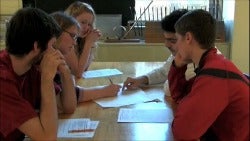
Physics Education Research is the systematic investigation of the teaching and learning of physics. Its goals include the improvement of student understanding of physics, improvement of teacher preparation in physics, improvement of student attitudes toward physics, and improvement of scientific reasoning skills and appreciation for the sciences among non-science majors, among others. Physics Education Researchers at Georgetown University are involved in developing, implementing, and assessing research-based curricula. Other projects involve the incorporation of technology into large lecture classes, and the development and assessment of physics courses for non-science majors.
Jim Freericks — strongly correlated electrons (charge and thermal transport and nonequilibrium effects), transport in multilayered nanostructures, resonant inelastic X-ray scattering, ultracold atoms in optical lattices (especially mixtures, dipolar molecules, and the Hubbard model) undergraduate understanding of quantum mechanics, student satisfaction with the major.
Amy Liu — structural, electronic, and vibrational properties of materials, including novel superconductors, thermoelectrics, charge-density-wave solids, clusters, and materials under pressure; assessment of undergraduate physics reform curricula and pedagogies